- Home
- BSH Trust
- Clinical Services
- Academics
- IQAC
- Research
- Sunaad School
- MTC
- Outreach Services
- Alumni
- Statistics
- Publication
- Media
- Collaborations
- CSR
- Blog
As the world observes International Noise Awareness Day on April 30, experts in Bengaluru have sounded a clarion call to be aware of the frequently overlooked risk of ear damage from headphones and earphones.
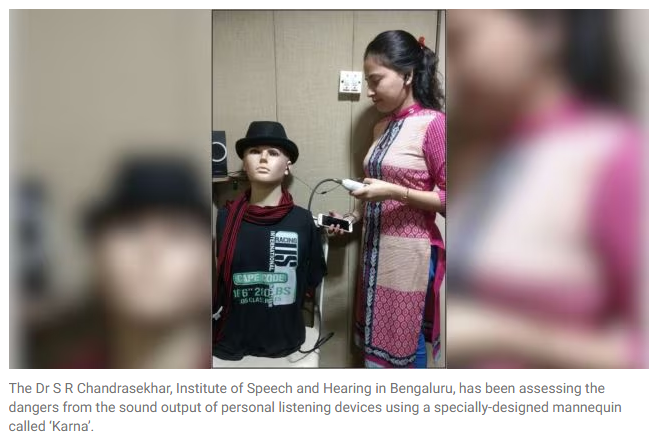
Devices such as earbuds and headphones play sound that ranges up to 130 dB in volume — something equivalent to being at live concerts and traffic intersections, says Varshini Ramdas, an assistant professor at the Department of Hearing Studies at the Dr S R Chandrasekhar Institute of Speech and Hearing in Bengaluru.
What comes to your mind when you hear the word ‘deafness’? Hopeful music in the background, with children wearing hearing aids and communicating with gestures?
Unfortunately, the mainstream portrayal of deafness has been often limited to this, while the management of deafness or hearing impairment is more advanced and will help in successful inclusion. March 3 of every year is commemorated as World Hearing Day and this is an annual campaign by the World Health Organisation for the prevention of deafness. Yes, you heard that right! Deafness due to various causes can be prevented.
How do I protect my hearing?
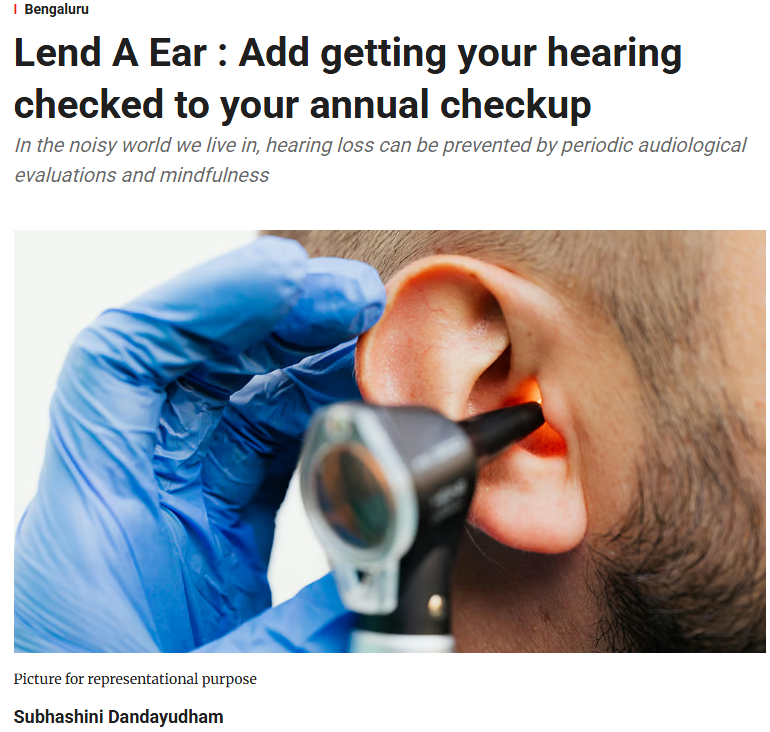
Following simple measures like avoiding loud noises, wearing earmuffs during concerts or a game in a stadium, limiting the use of listening devices or being mindful of volume levels in it, not pouring oil or water inside the ear canal, not inserting sharp objects to clean your ears and quitting smoking is a good start for it. But in the noisy world we live in, having periodical audiological evaluations is the best way to check your hearing capacity. Master health check-ups have become a norm which includes vision and dental, so why not hearing?
Enquire about it with your health provider and include it in your annual health screening to seek early intervention. Often people wait until it is too late and seek an audiologist’s support which can be avoided if you proactively choose to follow these simple steps alongside annual check-ups. It is natural that with ageing, hearing capacity may reduce but with early intervention and hearing aids, the outcomes are excellent. If you have an elderly individual at home, getting their hearing checked up is of paramount importance. Our hearing system is not just limited to the soft resilient ears – it has complex nerve connections to the brain and studies say that untreated hearing loss can lead to cognitive decline and social isolation. There is also the famous phrase, ‘Hearing health is brain health’ to evidence this. So, take action today and visit an audiologist to get your hearing checked!
What about children born with hearing loss?
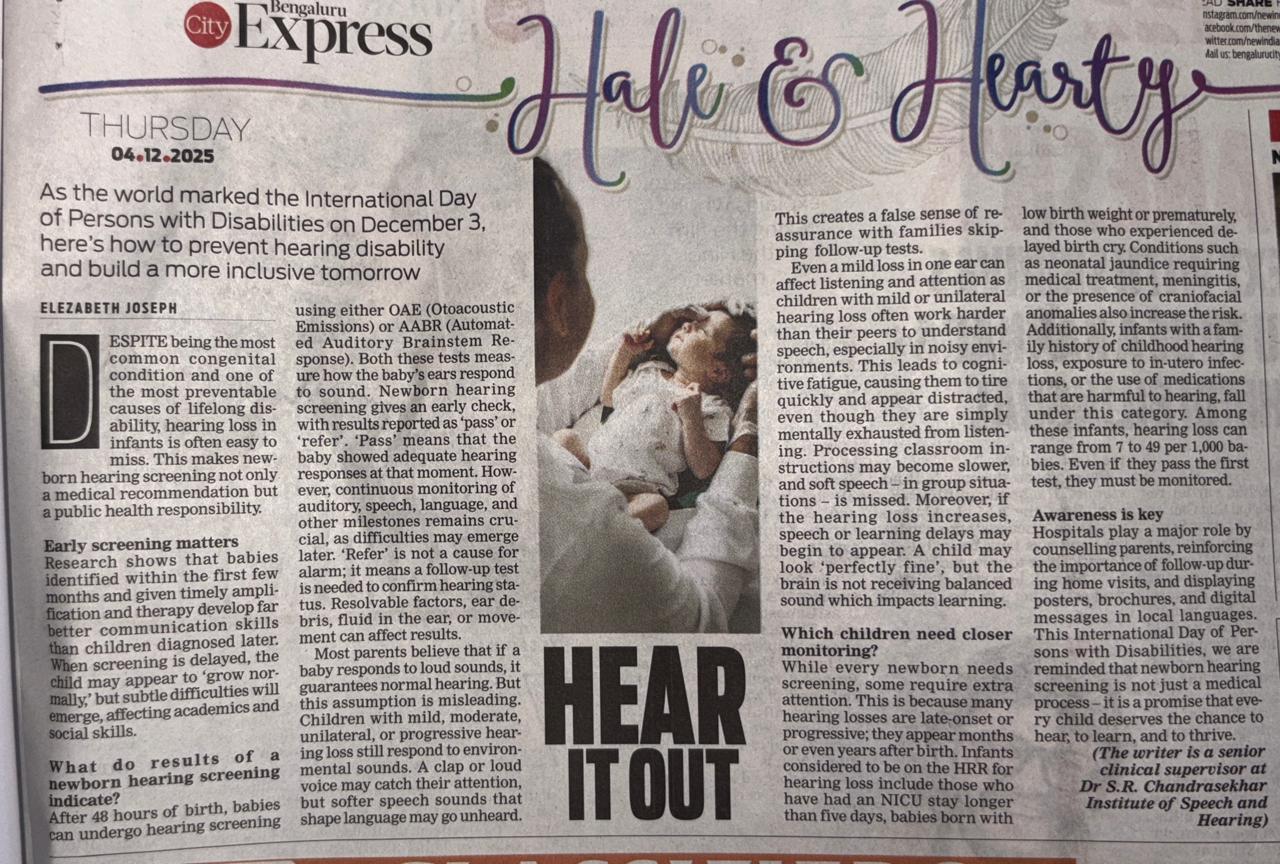
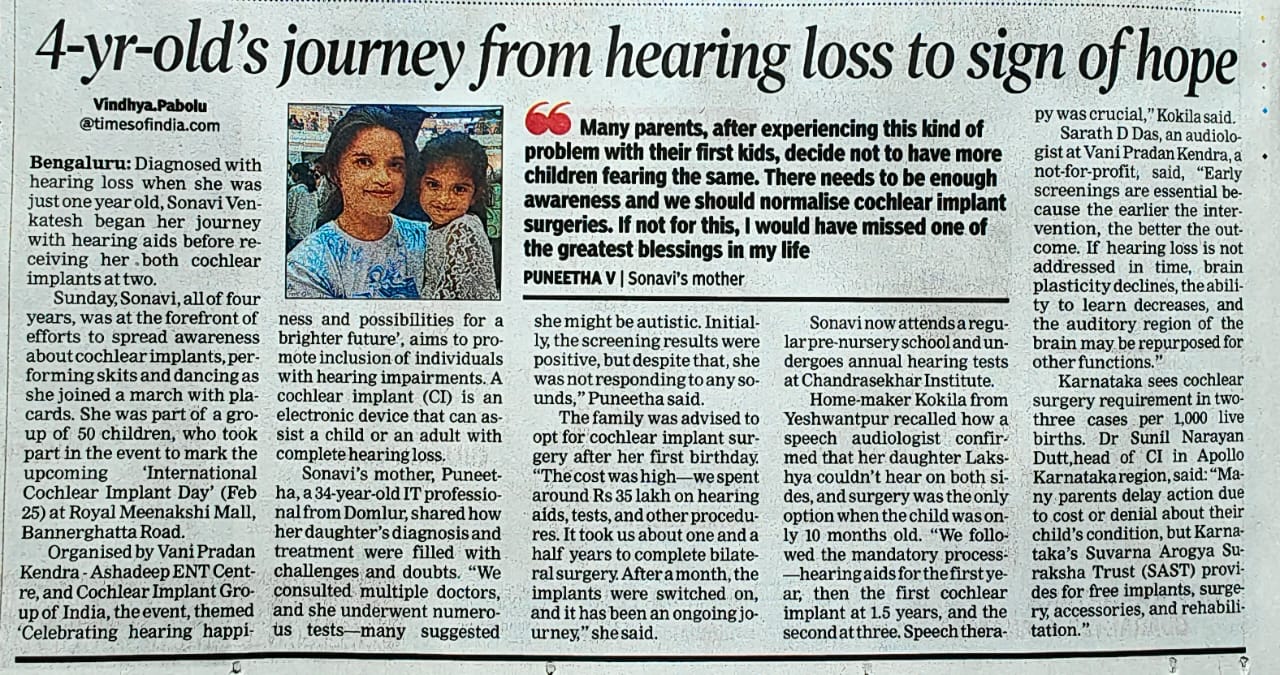
As per a 2024 study, it is estimated that for every 1,000 newborns, five are born with permanent hearing loss. This unfortunately is not preventable. But solutions are available and acting fast is the key. Hearing opens the world of sound to the newborn, from the loving voice of the mother to the chaos of the traffic outside the home, babies stay connected to the environment and learn how to make sounds and eventually speak. The brain maximally learns skills, including speech and language up to three years of age. The most potent period is up to one year of age. So, intervention for hearing loss should be within this age. That is where newborn hearing screening comes into the picture. This will help in identifying whether a newborn needs immediate intervention or not. Several countries have the newborn hearing screening, but in India, some states have implemented this while others are striving towards it. The Joint Committee on Infant Hearing, a global committee that works towards identifying, treating, and monitoring infants with hearing loss recommends hearing screening by one month of age, audiological diagnosis by two months of age, and enrolment in early intervention by three months of age. Intervention can be hearing aids or cochlear implants, which are successful. With hearing aids or cochlear implants, at an early age combined with auditory training and speech therapy, the child can attend mainstream schooling and have a successful life comparable to their peers. Unfortunately, awareness on this is less despite the efforts of several government and non-government organisations.
How can I contribute to change?
Advocacy is key. Advocate for newborn hearing screening in every situation that warrants it. It is as important as undergoing vaccinations. Urge the policymakers to schedule it alongside vaccinations and vision examinations for newborns. This will improve the detection rates and invariably contribute to more infants receiving the intervention and a better chance of having a typical childhood. Remember their ears might be tiny but they matter a lot!
No products in the cart.
We firmly believe that the internet should be available and accessible to anyone, and are committed to providing a website that is accessible to the widest possible audience, regardless of circumstance and ability.
To fulfill this, we aim to adhere as strictly as possible to the World Wide Web Consortium’s (W3C) Web Content Accessibility Guidelines 2.1 (WCAG 2.1) at the AA level. These guidelines explain how to make web content accessible to people with a wide array of disabilities. Complying with those guidelines helps us ensure that the website is accessible to all people: blind people, people with motor impairments, visual impairment, cognitive disabilities, and more.
This website utilizes various technologies that are meant to make it as accessible as possible at all times. We utilize an accessibility interface that allows persons with specific disabilities to adjust the website’s UI (user interface) and design it to their personal needs.
Additionally, the website utilizes an AI-based application that runs in the background and optimizes its accessibility level constantly. This application remediates the website’s HTML, adapts Its functionality and behavior for screen-readers used by the blind users, and for keyboard functions used by individuals with motor impairments.
If you’ve found a malfunction or have ideas for improvement, we’ll be happy to hear from you. You can reach out to the website’s operators by using the following email
Our website implements the ARIA attributes (Accessible Rich Internet Applications) technique, alongside various different behavioral changes, to ensure blind users visiting with screen-readers are able to read, comprehend, and enjoy the website’s functions. As soon as a user with a screen-reader enters your site, they immediately receive a prompt to enter the Screen-Reader Profile so they can browse and operate your site effectively. Here’s how our website covers some of the most important screen-reader requirements, alongside console screenshots of code examples:
Screen-reader optimization: we run a background process that learns the website’s components from top to bottom, to ensure ongoing compliance even when updating the website. In this process, we provide screen-readers with meaningful data using the ARIA set of attributes. For example, we provide accurate form labels; descriptions for actionable icons (social media icons, search icons, cart icons, etc.); validation guidance for form inputs; element roles such as buttons, menus, modal dialogues (popups), and others. Additionally, the background process scans all of the website’s images and provides an accurate and meaningful image-object-recognition-based description as an ALT (alternate text) tag for images that are not described. It will also extract texts that are embedded within the image, using an OCR (optical character recognition) technology. To turn on screen-reader adjustments at any time, users need only to press the Alt+1 keyboard combination. Screen-reader users also get automatic announcements to turn the Screen-reader mode on as soon as they enter the website.
These adjustments are compatible with all popular screen readers, including JAWS and NVDA.
Keyboard navigation optimization: The background process also adjusts the website’s HTML, and adds various behaviors using JavaScript code to make the website operable by the keyboard. This includes the ability to navigate the website using the Tab and Shift+Tab keys, operate dropdowns with the arrow keys, close them with Esc, trigger buttons and links using the Enter key, navigate between radio and checkbox elements using the arrow keys, and fill them in with the Spacebar or Enter key.Additionally, keyboard users will find quick-navigation and content-skip menus, available at any time by clicking Alt+1, or as the first elements of the site while navigating with the keyboard. The background process also handles triggered popups by moving the keyboard focus towards them as soon as they appear, and not allow the focus drift outside of it.
Users can also use shortcuts such as “M” (menus), “H” (headings), “F” (forms), “B” (buttons), and “G” (graphics) to jump to specific elements.
We aim to support the widest array of browsers and assistive technologies as possible, so our users can choose the best fitting tools for them, with as few limitations as possible. Therefore, we have worked very hard to be able to support all major systems that comprise over 95% of the user market share including Google Chrome, Mozilla Firefox, Apple Safari, Opera and Microsoft Edge, JAWS and NVDA (screen readers), both for Windows and for MAC users.
Despite our very best efforts to allow anybody to adjust the website to their needs, there may still be pages or sections that are not fully accessible, are in the process of becoming accessible, or are lacking an adequate technological solution to make them accessible. Still, we are continually improving our accessibility, adding, updating and improving its options and features, and developing and adopting new technologies. All this is meant to reach the optimal level of accessibility, following technological advancements. For any assistance, please reach out to